


Naming the connections
For the latest travel advice, I was advised to head from Pärnu southwards on the old coast road, and it’s been a magical day of wandering through berry-carpeted pine forests, boglands of dark ponds and stunted trees, straight out of a fairy tale, and along glacial erratic-strewn beaches of white sand.
This time it was a botany professor at Tartu University who guided me. I had woken up that morning slightly out of sorts, my doing entirely, and if nature can revive, today’s sojourn along the Baltic coast is proof.
During this visit to Estonia I have looked out for the places and situations holding a deep connection to Estonia’s ancient past. The sauna is one such; another is practising the ancient tongue and tapping into the country’s music and literature. And a third are the ecologies in the Baltic region that came to life after the ice sheets departed, 10,000 years ago.
There are traditional lifestyle aspects to consider, in which camping is only an echo. The dugout boat and skis, a log cabin or similar, and living off the land to the extent possible. That’s quite a commitment for now, so to lower one’s sights a little.
If you can name a plant, you come closer to it. That is one goal of a field trip at Puhtu where professor Tiiu Kull takes her first-year botany students. An Estonian farmer’s wife at the turn of the 20th century could recognise 150 different species of plant. We were unlikely to come anywhere close to this in an afternoon of poking around outside in the rain, although I have learned to recognise a few herbs that I didn’t know before.
The other source of knowledge are the information panels that adorn the numerous study walks around Estonia. A new plant for me is lavender-tea, a member of the rhododendron family. This looks a bit like rosemary, has white flowers, is common in boglands, and has a heady aroma that can cause headaches and drowsiness, and, supposedly, even put people to sleep, hence unerohi, or the sleep herb.
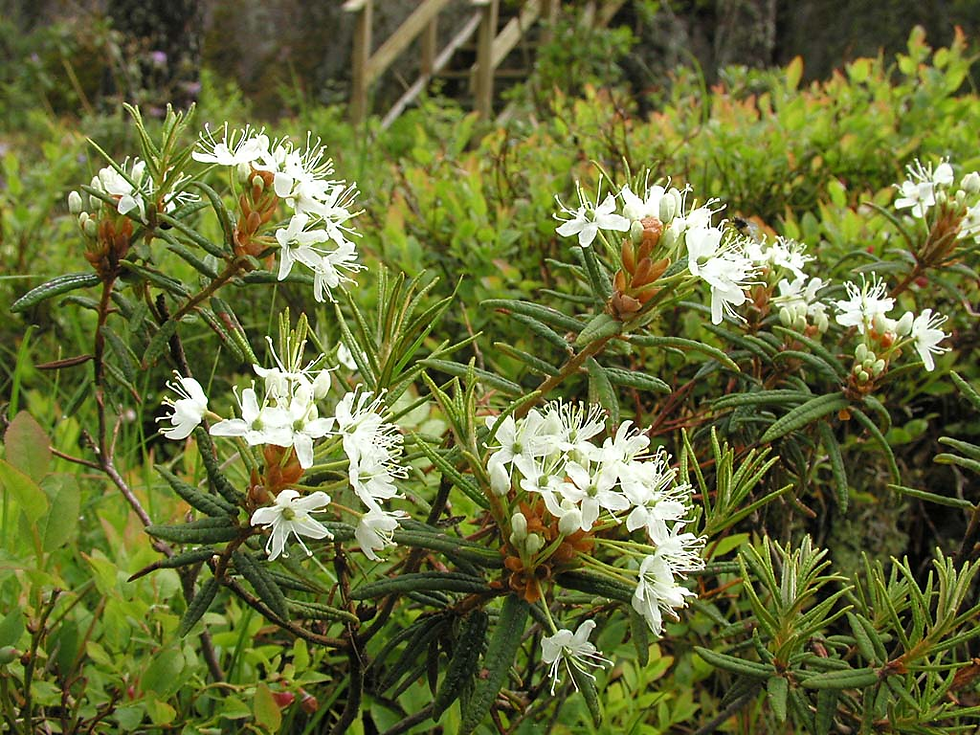
At another site, I learn that “beanleaf” or ubaleht is a water plant with a striking, white flower at the end of a long stalk. Legend has it that Jüri, a young farm worker, fled to an island in the middle of a bog lake to avoid the Tsarist army conscripting him, for 25-years’ service. At the same time a thick fog hid him from the soldiers chasing after him. There, Jüri came across a bog spirit who said he had commanded the fog, and then gave him magic boots to wear to cross the watery lands without having to flounder through mud, or swim. Home again, Jüri married and had children, and one autumn returned to the bog island with the magic boots, and gave the spirit – soovaim - a bag full of bean seeds by way of thanks.
The spirit was happy to see Jüri, took the boots and the beans and vanished into the marshes, spreading the seeds as he went. Every spring the ubaleht grows and the flowers open, shining white even at night to warn passersby to not fall into the water.
Among other striking plants are a native cabbage that grows at the seaside, and its leaves are good eating fresh in early spring. There is an artemisia that looks like the wormwood absinthe is made of but isn’t. I learn to distinguish between wild strawberries that do produce fruit and others that don’t. Wild roses are flowering in the forests, and yellow irises line sea and lakesides; they add atmosphere to a campsite for the night, back in the southeast of Estonia after a day of rain.


Comments