


The serpent-king people
It has been said of Estonians that their lives are closely tied to the lives of snakes, at least in the view of some Estonians. Adorning the wall of one home I visited is a representation of the serpent-king of legend. And yet the only snakes in Estonia are small things to be seen occasionally, harmless grass snakes, and venomous adders and vipers. When picking berries, my friends advise me to wear closed-in shoes and to tuck long trousers into my socks. So, what’s going on with Estonians and snakes?

Often sighted near the home, the grass snake or nastik is also called majauss, house snake. In some traditions, it manifested the soul of a family member who had passed away. According to Marju Kõivupuu’s book “Estonian mythology for the beginner”, the snake had a dual nature, belonging to the household, and at the same time belonging to the spirit world.
Before cats became the common house animals they are today Estonians put out milk for the majauss to feed on. Whether snakes drink milk seems unlikely, but what I did observe was respect for them wherever seen. In other folklore, snakes were more broadly a protective spirit of the household, a majavaim or house spirit. Killing one would bring misfortune.
“One recorded belief says that when entering an empty house, you should still greet it, because you are effectively greeting and blessing the house spirit, which will then bless you. So, the house isn't merely a building. It has a social and spiritual occupant.” (Chat GPT)
Another book recalls serpent symbolism, for example, the ouroboros of ancient Greece, a snake that circled around to eat its tail, an early representation of the infinite. Snake remains have been found in caves used by early humans, in Estonia as far back as the Mesolithic period. Reet Hiiemäe writes that an otherworldly interpretation of snakes in Estonia may stem from observing the fireplace, from which rises “twirling smoke like a squirming snake”.
A snake’s habit of shedding its skin as it grows would have added weight to this impression.
The serpent-king was a god associated with the amassing of wealth, and a guardian of wealth. Folk culture researcher Ahto Kaasik has written on Facebook that Estonia’s independence day, 24 February, was in tradition the “wake-up day” for snakes; on this day snakes return to life (from winter hibernation).
Folk wisdom shared on this day taught Estonians to protect themselves from summer insects, avoid snakes (the poisonous ones, presumably), and to read nature’s signs to forecast the weather. Snake-related traditions in rural Estonia persisted into the 20th century, and may still exist today.
For Ahto, it’s not chance that Estonia’s independence was announced on ussi äratamise päev. “As an ancient people, our roots go deeper than can fit into talk on feast days, or into school textbooks.” Even though the Estonian coat of arms is represented by three blue lions, instead of the three-headed, serpent-king (ussikuningas), Ahto sees no inconsistency.
Once a Danish symbol dating from the 13th and 14th centuries, the earliest record extant today of three lions today dates back to 1581, in Livonia under Swedish rule. The coat of arms persisted, and reappeared in 1856 as the coat of arms of the Estonia governorate in Tsarist Russia. Did Estonians think of these lions, possibly blue with cold in the northern climate, as representing the serpent-king?
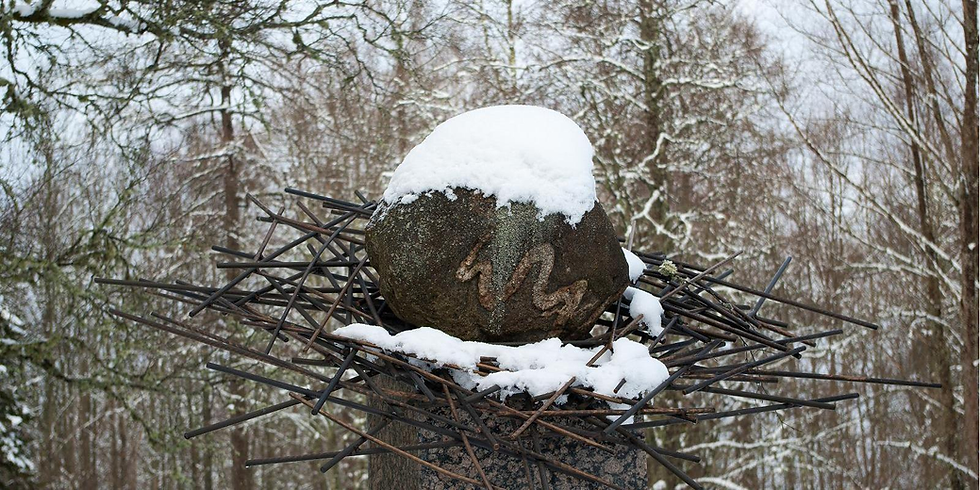
Artists have played with this theme. In 1915 Oskar Kallis designed a serpent-king tapestry which hung in the presidential palace in Kadriorg, Tallinn, until 1940 when the Soviets invaded. Film director and politician Mark Soosaar has said on the topic, “I don’t believe that lions (or leopards?) would be able to protect Estonia. They wouldn’t be able to start anything in snow or ice! Whereas the serpent-king holds an important place in our mythology.” He suggests the replacement of the three lions with the serpent-king, as the true symbol protective of the Estonian republic.
“We are a serpent-king people,” Ahto concludes.


Comments