


They fly to the beehive
Sunny and warm in the back garden, reading, and I catch in the distance the Estonian national anthem. Tiia messages me, saying there is a dance-and-choir event happening a few blocks down the road. I take a pot off the stove, quickly lock up, cross the road and through a stand of pine trees, and so it is. Hundreds are gathered and that’s just the performers: dancers in traditional costume, spinning in circles and weaving through each other, or waiting in the wings patiently for their turn. The music is through a PA, or a choir and mini-orchestra or piano; conductors take turns, a magician or sorceress conjuring voices in harmony, beautiful beyond description, the audience enthralled.
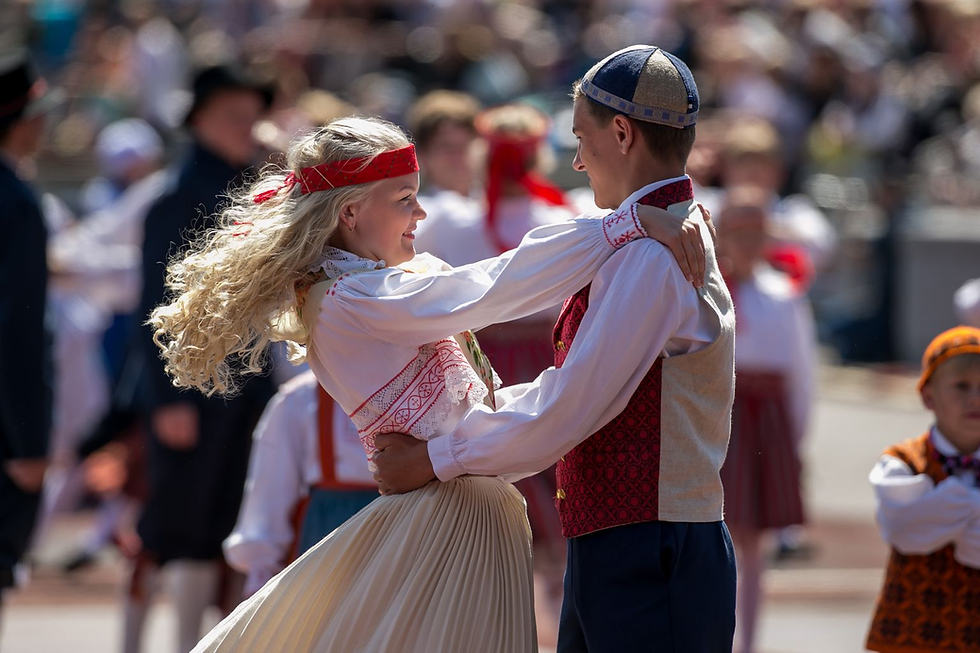
Courtesy of Postimees
In amongst verses in Estonian, a male choir from the Tallinn technical university sings "A Rocky Road To Dublin", a happy song choice for me, and an arrangement that could not fail to impress any Irish present.
There is a serious side to a laulu ja tantsupäev, a ritual going back who knows how long, a celebration of Estonianness, of national identity, and more recently the awakening of a people from the evil enchantments of times past. Song festivals took place in Tallinn as the Soviet era was drawing to a close. At that time Russian soldiers stood about, pointing rifles, supposedly there to observe any political dissent. They smoked cigarettes as the words of a Lydia Koidula poem were put to song and voiced at the close of each singing occasion.
“My homeland is my love, abandon it I shan’t,” is the one I am thinking of, and after three hours of non-stop performance, I hear the words, mu isamaa on minu arm, teda ei jäta ma, or so it seems to me - there are several verses, all slightly different – and tears well in my eyes, thinking of my grandma who never returned to Estonia from exile, and of my father who came back only once.
The festival draws to a close, the conductors and choreographers line up in front of a full choir, and the organisers hand to each woman and man a flower, a large white daisy – an Estonian tradition, again dating back to who knows when. A young conductor is called, a celebrity in his own time, and silence falls. The choir begins at a signal, and emotion overtakes me, the sung words of a Juhan Liiv poem, “they fly to the beehive”, nad lendavad mesipuu poole.
Two young women in my extended family have sung at the big song festival which takes place only every five years – this particular one is a suburban event – and they tell me that no matter how far in the world Estonians may live from home, our heart is always here, in Estonia. That is the meaning of the song. The choir ends in a flourish, and the crowd immediately calls korrata, for an encore, and the encore is the same song, even more emotional this time.
Earlier that I had been wondering what I was doing in Estonia. Livened up the drive westwards from Iisaku buying sets of kitchen utensils made of pale, close-grained juniper wood and practising my Estonian in the shop. Passing stands of birch, pine and spruce, and yellow fields sown in mustard seed, dark-coloured wood-built farmsteads at the fringes, I visit Käsmu on the northern Baltic coast. this was formerly a haunt of ships’ captains, and now a freshly painted collection of holiday homes, dispersed through forests, gardens and moss-covered fields of erratic boulders. And dancing and music: I wonder no longer.
The following evening saw me at a huge field like a cricket pitch, where another festival took place, this time dedicated to dance, at Lavassaare in the southwest of Estonia. The son of my third cousin was dancing at the Talisman event, as well as his 11-year-old daughter. This was an occasion for everyone: 2,200 dancers, around 200 in several troupes at any one time on the field. Many thousands of sheep had been shorn, and hectares of flax harvested to make the brightly coloured folk costumes, which I am told are time consuming and expensive to make. All performers are amateurs – this is a traditional pastime that has been increasing in popularity in recent years – although I imagine the choreographers and event organisers are professionals; certainly, they all enjoy celebrity status.
The MC in a deep, bass voice made it clear this once-every-four-years performance is a celebration of Estonian life, of thousands of years of tradition – children twirling on light feet, vigorous teenagers, lovelorn young adults, mothers and fathers, toilers in the fields and forests, and the older generation, manoeuvring sedately and respectfully of each other.
But the surprise here was the music, very varied and representing a wide range of genres: classical song, nursery rhyme, accordion-driven Cajun rhythms, gypsy or Balkan and Hungarian strains, an ancient chanting, and, most entertaining of all, hard rock played on bagpipes.


Comments