


The werewolf people
Updated: Dec 16, 2025
Everyone loves a werewolf story. To English speakers, werewolves are dangerous, unpredictable, and incredibly difficult to combat. Neither quite animal, nor quite human, they are unearthly and supernatural.
In JK Rowling’s Harry Potter series, professor Remus Lupin had been bitten by a werewolf, and every month for a week at the full moon would involuntarily transform into a vicious predator. Only by taking a magic potion could he retain his human mind while transformed. This was a werewolf with heroic qualities.
Quite different is the werewolf whom prince Caspian slays in the act of transformation, to prevent dark magic returning an evil witch to life, in CS Lewis’s The Chronicles of Narnia.
These and other stories serve to entertain, but this was not always so. At one time the people who lived in what is now Lithuania, Latvia and Estonia were known as “the werewolf people”, by neighbours and invaders. A pre-Christian legend told of a woman who transformed into a she-wolf, a naiselibahunt, a tale thought to be of Finnic origin.
Certain times of the year were the werewolf times, in southern Estonia and northern Latvia, and in Livonia of former times. Particularly at the equinoxes, and the summer and winter solstices. This was widely believed during the witch hunts and werewolf trials that beset northern and central Europe, and the Baltic region during the 16th and 17th centuries.
“Werewolf trials reached Livonia in the 17th century, and would become the most common form of witch-trial in that country,” says Wikipedia.
In 1651 a man called Hans, aged 18, appeared before a court in Idavere, in northeastern Estonia, on a charge of being a werewolf. He admitted he had hunted as a werewolf for two years, and that he learned how to transform into a libahunt from a “man in black”. The court found that Hans had undergone a magical transformation, mediated by the devil, and delivered a verdict of guilty of witchcraft, and sentenced him to death.
Between 1527 and 1725, Livonian authorities accused 18 women and 13 men of having “caused harm as werewolves”. The usual confession was that a person or devil had provided them with a wolf skin for use in a ritual, or they had eaten certain foods that enabled the transformation.
This time period saw the disappearance of the German-speaking Livonian Order as rulers, the Livonian War after which Poland-Lithuania prevailed, followed by Sweden, and then the Great Northern War, which saw Tsarist Russia victorious, and in place for the next two centuries.
In 1636 a woman from the village of Kurna in northern Estonia “claimed to have been taken into the woods by an old woman and given berries to eat, and then begun to hunt with the woman in the woods as wolves,” (Wikipedia).
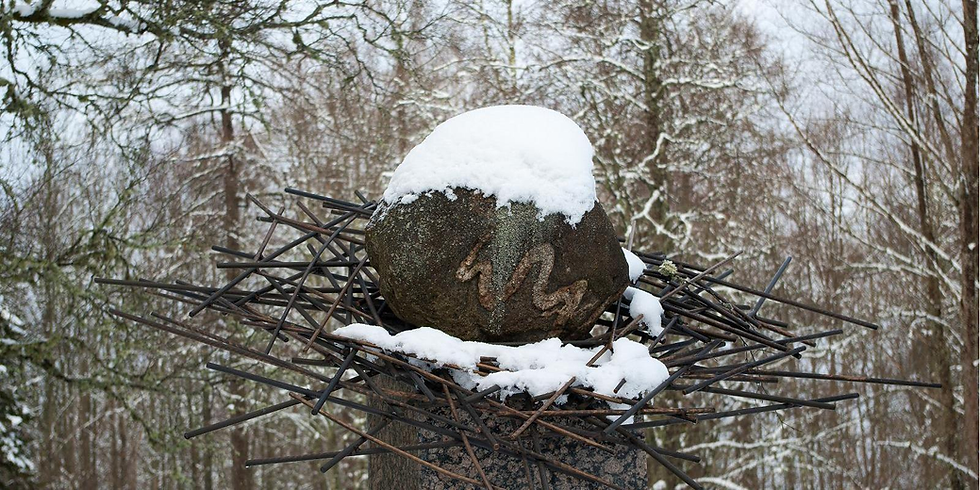
According to Marju Kõivupuu, in Estonian Mythology for the Beginner (2023), rituals to become a werewolf for women included wearing a wolf skin, reciting spells, and walking three times around an enchanted werewolf stone. Some stones are still known, one in Tulga marsh in Viljandi county, in southwestern Estonia, and another in Latvian Courland, formerly part of Livonia.
In other folklore, the seventh, or the ninth, or the 12th son of a family became a werewolf. Such an animal was smaller than a real wolf, and here’s a clue to the origin of the werewolf stories.

The wolverine or “glutton” is an aggressive carnivore of northern latitudes. In Estonian, the word for the largest of the mustelids, or of the weasel, mink, otter and badger family is ahm (glutton) or kaljukass (cliff cat).
Wolverines (little wolves) are the size of a medium dog, weigh up to 20kg, and they can down and eat animals many times their size, hence also the scientific classification Gulo gulo, from Latin, meaning gluttony.
At their largest areal extent, wolverines lived in the Canadian and Alaskan arctic, across northern Siberia and westwards into Scandinavia and the Baltic states. Unlike wolves, to which they are not related, wolverines lead solitary lives. They are said to eat their prey from the tail towards the head. In earlier times Finnic peoples felt this to be uncanny.
So, it is plausible that Finnic peoples regarded the wolverine as a human transformed into a wolf-like being, either willingly or by some other agency.
Such myths are also common throughout Finnic, as well as Slavic and Germanic peoples, and Estonian folklore has taken in stories from those traditions. One tells of a witch invited to a wedding feast where she feels slighted, and out of spite turns all the wedding guests into werewolves.
The purpose of a werewolf in Estonian tradition is unclear, unless it is to go hunting as a werewolf. Andrus Kivirähk used this theme in The Thresher, or November (2008). A man turns into a werewolf to hunt down a roe buck to feed his family. To do this, he tricks a slain animal from two real wolves; he retains his human mind as he hunts.
There’s a further clue to a northern Eurasian origin to the werewolf stories. The libahunt or seond inhabits a world of Palaeolithic hunter-gatherers, for whom “the shaman was a master of trance and ecstasy, whose visions and dreams encapsulate the ethos of the hunt, and gave it a spiritual meaning,” (Karen Armstrong, A Short History of Myth (2005)).
“Shamans operate only in hunting societies, and animals play an important role in their spirituality. During his training, a modern shaman sometimes lives with animals in the wild. He is supposed to meet an animal, who will instruct him … teach him animal language, and become his constant companion. In hunting societies, animals are not seen as inferior beings, but have superior wisdom.”
The shaman’s belief in trance via the agency of their spirit animal and, thus, entry into the spirit world is not shared by everyone. In ancient Greece, anyone who believed they were a werewolf was seen as a mental illness, and this view carried through into Mediaeval Islam. Today the condition is known as lycanthropy, and sufferers of it are said to be extremely rare.
Kõivupuu ends the werewolf chapter on a different slant: “A person who was different from others, and lived alone and isolated from the community was likened to a wolf living in the forest, with no children or animals.
“Someone who did not know exactly what they did, where they went, whom they met, or what they thought. Such a person inspired suspicion and fear – couldn’t he or she suddenly transform into a werewolf?”
A bit far-fetched - at any rate, such a person may be glad they are not living in the 1600s.


Comments